
The Complete Guide to Running a Profitable Photography Business
Roughly half of new small businesses fail inside five years, per the Bureau of Labor Statistics, and photography businesses don't beat that average. The cause is rarely the photography. It's the business — undercharging, undersigned, overwhelmed by client work nobody priced correctly in the first place.
I run Austen Hunter Photography, a portrait and headshot business alongside my full-time Navy Public Affairs career, and I was named 2024 Navy Civilian Photographer of the Year. The seven things below are what separate the photography businesses that scale from the ones that quietly shut down.

Key Takeaways
|
How to Price Photography Sessions for Profit
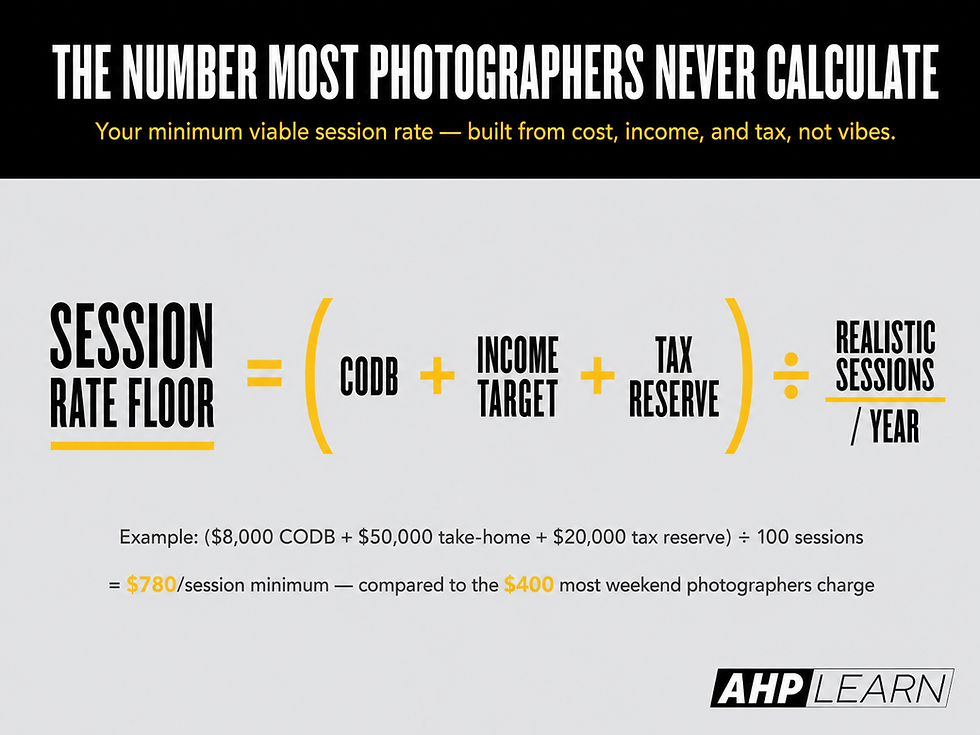
Don't price like a hobbyist. The right question isn't "what are other photographers charging" — it's "what do I need to net per session to make this business work?" Build that floor bottom-up from three inputs: cost of doing business, income you want to take home, realistic sessions per month.
Cost of doing business is every dollar leaving before any comes in — insurance, software, gear depreciation, website, storage, marketing, taxes. Add them up annually. Divide by sessions you'll actually shoot. That's what each session has to cover before you pay yourself.
Add what you want to earn. Most photographers want to net $40K to $60K a year. Shoot 100 sessions at $400 each, you gross $40K — then taxes, CODB, and editing eat half. Four sessions a month at $1,200 produces more take-home than ten at $400, with a quarter of the editing hours.
Discounting kills businesses faster than any other single mistake. You signal that your work is worth less than your sticker price, and you attract clients who'll leave the moment someone $50 cheaper shows up. I wrote a full breakdown on why I don't compete on price. The short version: any business that wins on price loses to someone willing to lose money.
Why Every Photography Business Needs a Contract
I have not met a working photographer who didn't eventually get burned by something a contract would have prevented. Disputed galleries. No-shows. Clients expecting commercial usage from a personal session. Most of these are preventable in the time it takes to drink a coffee.
A working photography contract needs four clauses: a retainer and cancellation policy (what's non-refundable, when), a turnaround commitment (how many images, how soon), usage rights (personal vs commercial — two licenses at two different prices), and a liability cap (what happens if your card fails, you lose images, you get sick).
Most new photographers either skip the contract or copy something off a forum that doesn't fit how they actually work. Both expose you. The second exposes you in a way that feels protected, which is worse.
"Your contract isn't an act of distrust — it's the document that makes the relationship safe enough for both sides to do real work." — Austen Hunter
You also need a model release for every paid shoot, even when you're not using images for marketing. The release establishes consent and protects you if a usage question surfaces years later.
Quick aside — I made my model release template free. Every paid shoot needs one, and the contract conversation goes smoother when you can hand a client something clean from the first inquiry. Grab it here.
Legal structure matters too. Sole proprietorship is fine your first year. But once you book regularly, an LLC gives you liability separation a sole proprietor doesn't. The SBA's breakdown of business structures covers the differences. Filing takes an afternoon and a few hundred dollars in most states. The protection is permanent.
For deeper coverage, the Photography Contracts 101 piece covers contract foundations and the legal tips for portrait photographers post covers copyright specifics.
Photography Business Taxes and Bookkeeping Basics
Separate your business finances from your personal finances on day one. Open a business bank account. Get a business credit card. Run every photography dollar through them. The reason isn't tax efficiency — it's that you cannot run a business if you don't know what the business makes.
Photographers who run everything through one personal account hit two predictable problems. They don't know what they earned (photography income mixed with day-job paychecks). And they routinely spend "business" money on personal things, then panic when quarterly estimates come due.
The 30-35% rule fixes this: the moment a session payment lands, move 30-35% to a separate account. Call it Taxes. Don't touch it. That money funds your quarterly estimated tax payments — the IRS expects them quarterly when you earn self-employment income, and missing them carries penalties. The other 65-70% is what you actually earned.
That percentage is high because self-employed photographers pay self-employment tax — 15.3% covering Social Security and Medicare on top of regular federal and state income tax. An employee splits Social Security and Medicare with their employer. As a self-employed business owner, you're both — so you pay both halves.

Sales tax is the trap most photographers don't see coming. In many states, photography services are taxable. In some, only product sales are. Rules vary by state and sometimes by county. Get this wrong and you owe back taxes plus penalties on every session you ever shot.
Expense tracking is where most photographers leave money on the table. Every expense you don't track is a deduction you don't take — gear, lenses, software, home-office percentage of rent, mileage, business meals, props. The IRS publishes the full guide to deductible business expenses. The rule across all of them: deductible if you can prove you spent it, lost if you can't.
I use a single business credit card and a 15-minute monthly habit of categorizing transactions. The return is roughly 20-30% lower tax bill, every year, forever. No better return on time exists in this business.
How to Find Photography Clients That Actually Pay
Most photographers chase the wrong clients. They build portfolios around what looks impressive on Instagram — moody fashion editorials, dramatic locations, perfect light — then wonder why their inquiries are families wanting beach portraits and corporate executives needing headshots. The portfolio sells one thing. The inquiries are for another.
Define your ideal client before building the portfolio. Who do you want to shoot? What can they pay? Where do they spend time? What problem are they hiring a photographer to solve?
My work comes from three channels. Referrals from past clients, because I ask at the right moment. Repeat business, because I follow up six months later. Local SEO, because I claimed my Google Business profile and asked every happy client for a review. Almost none from Instagram. The reels are visibility, not bookings.
For most working portrait and headshot photographers, a Google Business profile set up with the right categories and a steady drip of real reviews will outwork Instagram every year. Keeping clients is half the battle: how I keep portrait clients happy and rebooking covers the system.
The Mindset Shift From Photography Hobby to Photography Business
The single biggest change in my business happened the day I decided this was a business — not a hobby that occasionally made money.
That decision changes specific things. You set business hours. Replies go out during them, not at 11pm Sunday. You charge for consultations over 15 minutes. You say no to wrong-fit shoots — not every paying client is a good client. You raise prices on a schedule, not when guilt eventually forces you to.
There's a thing photographers do called "founder discounting" — pricing every session like a one-off favor. It feels generous. It actually trains your market that you're worth less than your sticker price.
The mindset piece is the hardest section here because it has nothing to do with the camera. Pricing requires believing you're worth what you charge. Contracts require believing your time is worth defending. Boundaries require believing your business is a business, not an extension of your goodwill.
Mindset and pricing are the two areas I cover most in 1:1 mentorship sessions. If working through this with me directly beats figuring it out alone, that's the door.
Why Business Systems Beat Camera Gear for Photographers
Most photographers over-invest in gear and under-invest in systems. A $2,000 lens won't make your photos sell for $2,000 more. A $20 contract template protects every session you book for the rest of your career. A booking platform automating your inquiry workflow saves ten hours a month, every month. Real bookkeeping catches every deduction at tax time, every year.
The math isn't close. Gear is a one-time return — better images on the few sessions where it matters. Systems compound. Every session, every client, every tax year.
I'm not anti-gear — I wrote a separate guide on the gear that actually matters for portrait work. But the order matters: contracts, bookkeeping, booking workflow, then gear upgrades. Most photographers do this in the exact opposite order and wonder why their business doesn't scale.
"A $20 contract template will protect every session you book for the rest of your career. A $2,000 lens won't." — Austen Hunter

What a Photography Business Looks Like at Year 1, Year 3, and Year 5
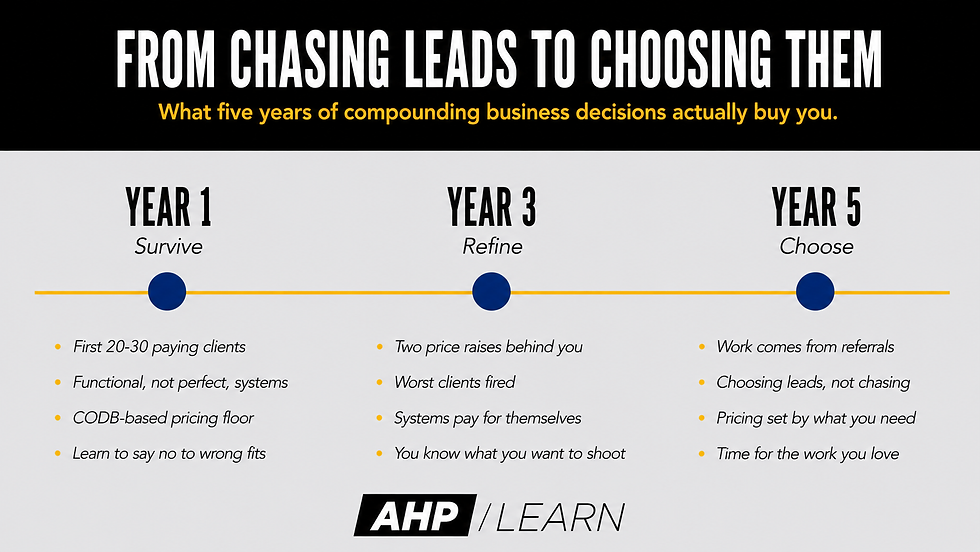
Year one is survival. Find your first 20-30 paying clients. Get reps. Build basic systems — functional, not perfect. Charge what covers real CODB. Learn to say no to one wrong-fit booking per month.
Year three is refinement. You know what work you want to do. Pricing has raised at least twice. You've fired your worst clients (40% of hours, 10% of revenue). Systems pay for themselves.
Year five is optimization. Most work comes from referrals and repeats. You're choosing leads, not chasing them. Pricing is set by what you need. You have time for the high-end work that makes you actually love photography.
The compounding is what most photographers miss in year one. Every system built in year one pays back every year afterward. Every relationship becomes a referral source for the next decade.
Year | What Most Photographers Do | What Profitable Photographers Do |
Year 1 | Underprice, overdeliver, panic at tax time | Set CODB-based floor, contract every session, run the 30-35% rule |
Year 2 | Burn out, blame the market, drop prices | Raise rates 15-20%, fire worst clients, build referral systems |
Year 3 | Pivot to weddings or commercial work to "scale" | Refine ideal-client filter, double down on the work that pays best |
Year 5 | Quit photography, return to a day job | Operate from referrals, choose work, charge what's needed |
How to Start Building Your Photography Business This Month
Pick the section above that made you most uncomfortable. That's the one to fix this month. Don't try to overhaul everything at once.
If pricing is your bottleneck, run the cost-of-doing-business math at the top of this guide. If your taxes are a mess, open the business bank account this week and start the 30-35% rule on your next session payment. If contracts feel scary, download the free model release and use it on your next shoot.
The photographers who scale aren't the most talented. They're the ones who decided this was a business and built the systems to back the decision up.
If you want help applying this to your specific business, I run 60-minute 1:1 mentorship sessions covering craft and business. We can dig into whichever section above is costing you most right now.
Frequently Asked Questions
Do I need an LLC to start a photography business?
Not legally — you can operate as a sole proprietor from day one. But once you start booking regularly, an LLC gives you liability separation a sole proprietor doesn't. Most working photographers form one within their first year.
How much should I charge for my first photography session?
Build it bottom-up: cost of doing business plus the income you need plus your tax reserve, divided by the realistic number of sessions you'll book. That's your floor. Many photographers price their first sessions far below this number, then can't ever raise prices on those clients without losing them.
What business systems do photographers need first?
A real contract — not one copied off a forum. Then a business bank account separate from your personal account. Then the 30-35% tax rule. Everything else flows from those three.
Can I run a photography business alongside a full-time job?
Yes — many of the most successful photographers I know do exactly that. The dual-income safety net lets you make better pricing decisions because you're not desperate for any single booking.
When should photographers raise their prices?
When you're booking more than you can comfortably deliver. When you're consistently saying yes to clients you'd rather not work with because you "need the income." When your prices haven't moved in 18 months. Any one of those is the signal.


Comments