
How to Approach Strangers for Street Portraits (Lessons from a Tokyo Shrine)
I've stood in front of a Navy admiral and told him exactly where to stand. I've directed wedding parties of forty people through coordinated lighting setups. None of that prepared me for the moment I had to walk up to a stranger at Senso-ji Shrine in Tokyo and ask, in broken Japanese, if I could take her photo.
My hands were shaking. My script was three memorized phrases. And the people I wanted to photograph might not even speak Japanese.
If you've ever wanted to try street portraits but talked yourself out of it, you already know this feeling. The technique tutorials on YouTube skip past it like it doesn't exist — but it's the actual reason most photographers never try this kind of work. I'm Austen Hunter, the photographer behind Austen Hunter Photography and 2024 Navy Civilian Photographer of the Year, and after a week of approaching strangers in Tokyo I want to share what actually works — and why this is the most valuable practice I've forced myself to do in years.
Key Takeaways
|
Why Approaching Strangers Feels Harder Than Photographing an Admiral
Inside the studio, I have a title doing some of the talking for me. People know I'm there to make them look good. They've already agreed to be photographed. The structure of the situation gives me permission before I open my mouth.
On the street, none of that exists. You're a guy with a camera. The title that usually anchors you is gone, and what's left is just you, holding gear, asking a person you've never met to trust you for ninety seconds. The gap between your normal working identity and your stranger-in-public identity is what makes the heart rate spike. The camera didn't get heavier. The job did.
In Tokyo I felt this twice as hard, because I couldn't even fall back on language to fill the gap. The forced humility was uncomfortable, and that turned out to be the lesson.
The 4-Step Framework I Use to Approach Strangers
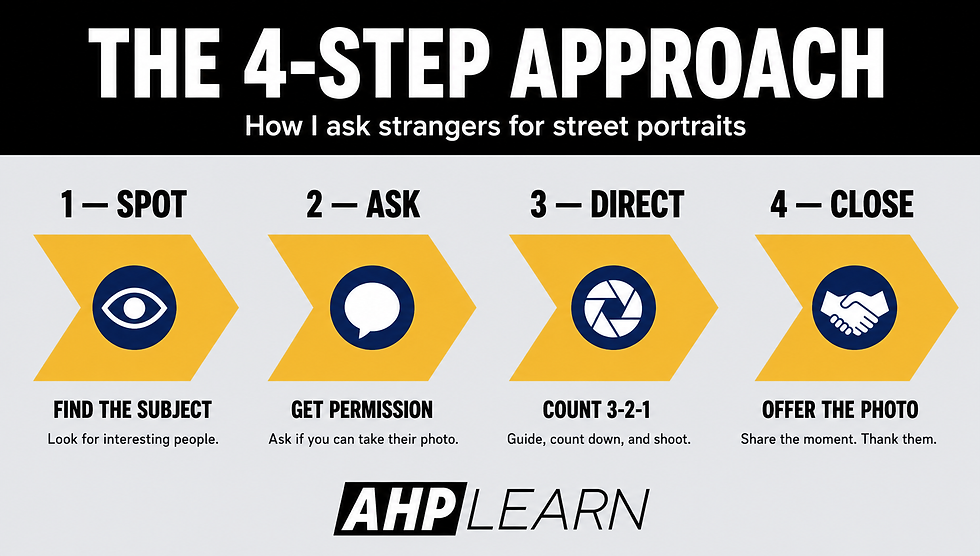
I don't write a script. I have a sequence — the same four moves, every time:
1. Spot the right subject. A portrait needs a subject worth photographing. That doesn't mean conventionally beautiful — it means visually interesting. Someone wearing something distinct, doing something unusual, or carrying themselves in a way the eye lingers on. At Senso-ji, the kimonos were the obvious draw. In your hometown it might be the older man with the perfect mustache, the kid in a vintage band shirt, the couple holding identical cameras. Look for the photograph before you look for the person.
2. Open with permission, not a pitch. I never explain who I am or list credentials. I ask, in the simplest way the situation allows: Can I take your photo? Sometimes I add one sentence — You look great, would you mind? — but I never sell. People hear a pitch coming from a block away, and pitches put them on guard. A sincere short question gets a sincere short answer.
3. Direct without overdirecting. Once they say yes, take the photo within thirty seconds. I count down — three, two, one — every time. It does two things: it tells them exactly when the shutter will fire so they're ready, and it gives me a clean repeatable rhythm so I'm not standing there fumbling. I'll give one or two small directions ("can you turn this way so I can see the obi"), but I treat their time as a gift and don't burn it.
4. Close with respect. When I'm done I show them the back of the camera, thank them in their language if I can, and offer to send the photo. The "send the photo" part matters — it makes the exchange feel like a trade rather than a take. Half of them will give you their Instagram. A few will become friends. That moment is what makes the next stranger easier.
"The fear isn't about photography. It's about who you are without the title that usually does the talking for you." — Austen Hunter
The Respect Rule for Travel and Cultural Portraits

Photographing someone in their cultural dress in their own country is a different conversation from photographing the same person on a fashion set. The line between celebration and exploitation is real, and it gets crossed more often than photographers want to admit.
The rule I use: cultural curiosity plus explicit permission plus a generous exchange equals a portrait that earns its place in your portfolio. All three. If I'm just admiring the kimono and snapping a photo without asking, that's exploitation. If I ask but I don't actually care about who's wearing it, the exchange is hollow. If I care, ask, and offer something back — a copy of the photo, a tag, a moment of real connection — the portrait belongs.

In Tokyo I told the women in kimono that we don't really see this in the United States, and that I wanted to bring those photos home so other people could see what I was seeing. Every single one of them lit up. The respect was the offer.
What to Do When You Don't Speak the Language
Three tactics work, and none of them require fluency.
The first is to memorize one phrase: "Excuse me — photo?" In Japanese: "Sumimasen, shashin?" In Spanish: "Perdón, una foto?" In French: "Pardon, une photo?" That's it. You don't need fluency, you need permission. One word and a raised camera, with a smile, communicates the whole transaction.

The second is to lead with the camera, not the words. Holding your camera up slightly and gesturing toward the person communicates intent across every language barrier I've encountered. The body language is the question.
The third is to keep your phone translator open as a backup — not as the primary tool. Pulling out a phone first kills the moment. Pulling it out after a yes lets you say something specific later, like "where are you from" or "I love your outfit." Use it as a follow-up, not an opener.
Common Fears vs. The Reality
What you're afraid of | What actually happens |
They'll say no | Most people say yes — many feel flattered to be asked |
They'll think you're creepy | A short clear ask reads as confident, not creepy |
You'll waste their time | A 30-second portrait is a small ask, especially when you offer the photo back |
They'll demand money | Almost no one does — and a polite "no problem" closes the moment |
You'll be rejected and feel terrible | The first no stops mattering after the second yes |
Quick aside — I built a free portrait photography guide that covers the technique side once you've gotten past the fear: posing, light, composition, the things that make the portrait worth taking. Grab it if you want a head start on the craft side of this work.
The Fear Is the Point
Here's the part the technique tutorials skip: the discomfort itself is the skill. Every time you ask a stranger and survive a no, every time you ask and they say yes, you build a tolerance for being uncertain in public with a camera. That tolerance transfers everywhere. Studio sessions feel easier. Awkward client moments feel smaller. The next time you walk into a room you don't belong in for a job you really want, the muscle is already there.

If you want to build the technique side alongside the courage side, my Complete Portrait Photography Guide walks through the lighting, posing, and gear decisions that separate a snapshot from a portrait. Pair it with a few practice strangers and you'll move faster than you think. For another behind-the-scenes session breakdown in this same vein, here's the Tokyo cousin to my graffiti warehouse cinematic-portrait shoot — same mindset, very different setup. And if you want to know the five portrait photography mistakes I see most often, that post pairs nicely with this one — most of them are about confidence as much as technique.
I came back from Tokyo with a folder of portraits I love. But the more useful thing I came back with was a slightly higher ceiling for what I'm willing to do with a camera in my hand. That's the real work. The photos are the souvenir.
Frequently Asked Questions
Do I need a model release for street portraits?
For personal portfolio use in most countries, no — taking a photo of a person in a public place with their consent is generally allowed. For commercial use (selling the image, licensing it for advertising), you usually do need a release. When in doubt, get one signed. I cover this in more detail in my legal tips for portrait photographers post.
What lens is best for street portraits?
A 35mm to 85mm prime lens does most of the work for me. Wide enough to keep some context behind the subject, long enough to flatter the face. I'm not a fan of standing twenty feet away with a 200mm — it makes the interaction feel like surveillance instead of a portrait. Outdoor shrine light is soft enough that you can also rely on natural light here — I unpack the why in my natural light portrait photography tips post.
How do I approach someone if I don't speak the language?
Memorize one short phrase ("Excuse me, photo?"), lead with the camera held slightly up, and smile. If they say yes, use a phone translator after the fact to add specificity. The opener should always be human and short.
Is it disrespectful to photograph people in cultural dress?
Only if you skip the asking and the exchange. Cultural curiosity, explicit permission, and a generous offer back — a copy of the photo, a tag, a moment of real connection — turn the portrait into a collaboration rather than a take.


Comments